Does archaeology support the Bible or challenge it?
Archaeological discoveries provide a tangible bridge between ancient scripture and physical history. For over two centuries, excavations across the Near East have uncovered inscriptions, artifacts and monumental structures that align with the biblical accounts. These findings do more than just provide context; they offer primary evidence that corroborates the figures, locations and events described in the Old and New Testaments.
While the Bible's theological messages are central to faith, its historical claims are subject to rigorous scholarly inquiry. Archaeology, as a discipline, seeks to uncover material evidence from the past and it has frequently validated the biblical accounts, transforming myths into established history and silencing long-standing academic skepticism.
No archaeological discovery has ever conclusively disproven a biblical event.
In contrast, hundreds of finds have provided physical confirmation of people and places once thought to be fictional.
Why do archaeologists disagree about the Bible?
When exploring whether the Bible is historically accurate, it is essential to understand the tug-of-war between the two primary schools of thought that interpret every discovery. While two archaeologists may look at the exact same stone foundation, they each interpret things differently, depending on their perspective.
The Maximalist position argues that the biblical records should be treated as a reliable historical framework unless archaeological evidence proves it wrong. Maximalists point out that the Bible contains thousands of precise geographical, cultural and political details that align perfectly with the ancient Near Eastern world. For them, "absence of evidence is not evidence of absence." If we haven't found a specific palace yet, it doesn't mean it never existed - it just means it's still buried. They use the Bible as a primary historical map to guide their research.
The Minimalist school (often called the Copenhagen School) takes the opposite view. They argue that the Bible is primarily a work of theological fiction or national folklore composed centuries after the events it describes. To a Minimalist, no biblical figure or event is considered historical unless it is corroborated by an external, non-biblical source - such as an Assyrian tablet or a stone monument. Without a "signed" inscription, they assume the story is a myth.
For a long time, the minimalist view was the vogue in academic circles, casting doubt on everything from the Exodus to the United Monarchy. However, over the past few decades, the "spade" has increasingly tended to favor more maximalist interpretations, with a number of significant archaeological discoveries challenging earlier skepticism. Several figures once dismissed as legendary or literary have been reassessed in light of material evidence: King David, for example, was long compared to figures such as King Arthur, yet the Tel Dan Stele is widely cited as evidence for the "House of David" as a historical dynastic entity. Similarly, the Hittites were once regarded by some scholars as a biblical invention, but are now well established as a major ancient Near Eastern civilization with extensive archaeological and textual attestation. Pontius Pilate, too, was questioned in earlier scholarship until the discovery of the Pilate Inscription at Caesarea in 1961 provided clear evidence of his historical role as prefect of Judea.
6 Archaeological finds that changed ancient history
The Tel Dan Stele: Evidence for King David
Significance: The inscription is widely interpreted as stating, "I killed [Ahaz]iah son of
[Jehoram] of the House of David." It is generally regarded as the earliest known extra-biblical
reference to the "House of David," indicating the existence of a dynastic name associated with
David in the 9th century BC.
Bible: This inscription is broadly consistent with the events described in
2 Kin 8:28, which
recounts the reigns of the kings mentioned in the biblical records.
The discovery of the Tel Dan Stele is widely considered one of the most significant moments in biblical archaeology. For decades, the "minimalist" school of thought dominated biblical scholarship, arguing that King David was little more than a literary fiction; a mythic figure akin to King Arthur, concocted centuries later to provide Israel with a glorious, legendary origin story. Critics claimed that if a king as great as David had truly ruled a vast empire from Jerusalem, he would surely have left a footprint in the archaeological record. In the early 1990s, that skeptical narrative was shattered.

The Tel Dan Stele on display at the Israel Museum, Jerusalem. Photo by Oren Rozen, via Wikimedia Commons. licensed under CC BY-SA 4.0

In 1993, during excavations at Tel Dan in northern Israel, archaeologist Gila Cook noticed a stone fragment used as secondary building material in an ancient wall. Upon turning it over, she discovered it was a piece of a basalt victory monument (a stele) covered in Old Aramaic script. Two additional fragments were recovered in 1994.
Dating to the 9th century BC, roughly 150 years after David's reign, the inscription was commissioned by a King of Aram (most likely Hazael of Damascus). In the text, the Aramean king boasts of his military triumphs over his southern neighbors. The most explosive line in the inscription reads, "…I killed [Jeho]ram son of [Ahab] king of Israel and I killed [Ahaz]yahu son of [Jehoram] king of the House of David (Beit David)…"
Its reference to the 'House of David' provides the first extra-biblical evidence of David's existence, proving that his name wasn't just a late-date theological invention. It provides historical validation by confirming the existence of a Judean dynasty explicitly named after David. For a foreign adversary to refer to the kingdom as the "House of David," David himself must have been a figure of immense historical weight - the literal founder of the royal line.
It also corroborates scripture, the stele mentions the kings of Israel and Judah in the exact same dynastic context found in the Books of Kings and Chronicles, aligning the biblical records with secular accounts. It proved that the biblical authors were recording real history involving real people, anchoring David's reign firmly within the timeline of the ancient Near East.
The Pilate Stone: Roman proof for Pontius Pilate
Significance: The inscription includes the name "Pontius Pilate, Prefect of Judea," providing
archaeological evidence for the historical figure known from Roman sources and the New Testament.
Bible: Mat 27:2
refers to Pontius Pilate as the Roman governor, consistent with the title and role indicated by the
inscription.
Pontius Pilate, the Roman governor of Judea from 26–36 AD, is a central figure in the Gospel accounts of Jesus' crucifixion. While historical records on Pilate were once limited to literary sources like the Gospels, Josephus and Philo; a groundbreaking archaeological discovery in 1961 confirmed his historical existence - the Pontius Pilate Inscription.
Unearthed at Caesarea Maritima, the Roman administrative capital of Judea, the limestone block was found during excavations at a Roman theater by Italian archaeologists led by Antonio Frova. The Latin inscription reads: "Pontius Pilate, Prefect of Judea, has dedicated [this] to the people of Caesarea in honor of Tiberius Caesar." This stone confirms Pilate's existence, his official title as Prefect of Judea and his service under Emperor Tiberius, corroborating the timeline and authority structure described in the New Testament.

An inscription bearing the name of Pontius Pilate, Procurator of Judea, in the time of Yeshua of Nazareth, Photo by BRBurton, via Wikimedia Commons, licensed under CC BY-SA 4.0

The Pilate Stone is one of the most important archaeological confirmations of a New Testament figure. Until its discovery, skeptics questioned whether Pilate was a historical person or a literary invention. This artifact silences such doubts by placing Pilate in a real Roman administrative context, with a title and locale that match Gospel accounts. Moreover, the use of the title Prefect - rather than Procurator, a later designation offers deeper insight into Roman governance in the early 1st century. It also confirms Caesarea Maritima, not Jerusalem, as the seat of Roman power in Judea, aligning with known Roman provincial practices.
Pilate plays a pivotal role in the Gospels. All four Gospels describe him presiding over Jesus' trial and ultimately authorizing the crucifixion. Although portrayed as reluctant, he capitulates to public pressure, an act that reflects the volatile political climate in Judea under Roman rule. Pilate's symbolic act of washing his hands (Mat 27:24) communicates his desire to avoid responsibility, but history records him as the one with ultimate authority. The inscription doesn't reveal Pilate's personal views or motives, but it verifies his position of power at the time and place where the Gospels place him. It reinforces the Bible's portrayal of a Roman governor navigating the tensions between imperial demands and local unrest.
Combined with literary references from ancient historians and the New Testament, the Pilate Inscription strengthens the case that the events surrounding Jesus' crucifixion occurred in a real historical framework. It validates the existence of the Roman figure most directly involved in the trial and execution of Jesus - one of the most pivotal moments in Christian belief.
The Merneptah Stele: The earliest reference to Israel
Significance: The inscription includes the line, "Israel is laid waste; his seed is no more."
It is widely regarded as the earliest known reference to Israel outside the Bible, identifying
Israel as a people group in Canaan rather than a settled state.
Bible: This Egyptian record is broadly consistent with the biblical portrayal of Israel's
emergence in the land during the early Old Testament period (e.g., Exodus–Joshua).
The Merneptah Stele serves as the ultimate "receipt" for the early existence of Israel. In the world of historical criticism, a common skeptical trope is that the nation of Israel was a late-stage invention–a group of tribes that didn't coalesce into a distinct identity until centuries after the Bible claims. The Merneptah Stele (c. 1208 BC) effectively demolishes that theory with ten feet of black granite. It contains a poetic summary near the bottom that changed when Israel was recognized as a nation, "Canaan is captive with all woe. Ashkelon is conquered, Gezer seized, Yanoam made as though it never existed. Israel is laid waste, its seed is scattered."

Treaty of Kadesh circa 1269 BC, between Pharaoh Ramesses II and Hittite king Hattusilis, Photo by Fae, via Wikimedia Commons, licensed under CC BY-SA 4.0

This discovery is a cornerstone of biblical credibility because it is the earliest extra-biblical mention of "Israel" ever found and it forces historians to reckon with a reality that aligns perfectly with the biblical timeline of the period of the Judges.
The most profound evidence isn't the name itself, but the grammar surrounding it. Egyptian scribes were meticulous. By using the hieroglyphic determinative for a people group rather than a city-state, they officially recognized Israel as a distinct ethnic and cultural entity. This isn't a reference to a minor village; it is a reference to a nation. For Pharaoh Merneptah to boast about wasting their seed, Israel had to be significant enough to warrant a military campaign by the ancient world's superpower. This confirms that by the late 13th century BC, Israel was not just a fledgling group of nomads, but a formidable presence in the Levant.
This find provides an objective, external witness that predates the Babylonian exile by over 600 years. This confirms that by 1208 BC, shortly after the period of the Judges, Israel was already a significant and recognizable entity in the land of Canaan. It wasn't a fledgling tribe or a later invention of post-exilic writers; they were a distinct nation already established enough to be considered a conquest worthy of a Pharaoh's boast. It proves that the Israel of the Bible wasn't a retrospective fiction created by later writers, but a living, breathing and resisting nation in the land of Canaan during the exact window the Old Testament describes.
The Merneptah Stele reminds us that even when the enemies of Israel sought to celebrate their destruction, they inadvertently preserved the evidence of their existence. It turns a Pharaoh's boast into a testament of biblical reliability.
The Hittites: A rediscovered ancient civilization
Significance: References such as "Uriah the Hittite" reflect the biblical awareness of a
people once thought by some scholars to be purely literary, but now known from archaeology to have
been part of a major Bronze Age civilization.
Bible: (2 Sam 11:3)
and passages in Genesis indicate the presence of Hittites in the ancient Near East, consistent with
extra-biblical evidence that they were a real and influential people.
The Hittites appear in the biblical accounts over 50 times, spanning the era of Abraham's land purchases to the reign of King David, who famously counted Uriah the Hittite among his elite "mighty men." For nearly a century, however, secular historians dismissed these references as purely legendary. Critics argued that if a nation of such purported scale had existed, they surely would have left a footprint in the archaeological record.
The silence was broken in 1906 when German archaeologist Hugo Winckler began excavating a site in central Turkey called Boghazköy. He didn't just find a settlement; he uncovered Hattusa, the massive, fortified capital of a "lost" superpower.

The Lion Gate flanked by two towers, located at the southwest of the city of Hattusa, capital of the Hittite Empire, Photo by Carole Raddato, via Wikimedia Commons, licensed under CC BY-SA 4.0
.jpg)
The excavation unearthed a royal archive of over 10,000 clay tablets written in cuneiform. These records transformed our understanding of the ancient world. Among the tablets was a peace treaty between the Hittites and Ramesses II of Egypt. This document confirmed that the Hittites were not a minor tribe, but a geopolitical equal to the Egyptian Empire. Czech scholar Bedřich Hrozný eventually deciphered the script, revealing it as the oldest known Indo-European language, providing a missing link in linguistic history.
The rediscovery of the Hittite Empire is a landmark case in biblical archaeology. It serves as a stark warning against the "argument from silence" - the assumption that if evidence for a biblical person or place hasn't been found yet, it must not exist.
Far from being fictional, the Hittite Empire dominated the Near East for over 500 years, rivaling Assyria and Egypt. Furthermore, archaeological records now show the existence of Hittite buffer states and migrations extending into the Levant - exactly where the Bible places them during the time of the Patriarchs and the Monarchy. The missing civilization didn't just exist; it was exactly as the Bible described it.
The Dead Sea Scrolls: Texts that preserved scripture
Significance: Among the oldest surviving manuscripts of biblical texts, these scrolls (dating
from the 3rd century BC to the 1st century AD) provide important evidence for the transmission of
the Hebrew Scriptures over time. The Isaiah Scrolls proved to be word-for-word identical with
the standard Hebrew Bible in more than 95% of the text, confirming the accuracy and reliability of
the Masoretic Text.
Bible: Copies of books such as Isaiah show a high degree of consistency with later manuscripts,
supporting the general stability of the text across centuries
(Isa 40:8).
The Dead Sea Scrolls, discovered between 1947 and 1956 near the Dead Sea in Israel, are among the most significant archaeological finds of the 20th century. Dating from roughly 250 BC to 68 AD, these manuscripts include fragments from every book of the Hebrew Bible except Esther. They provide a remarkable window into the state of Scripture centuries before the time of Christ and demonstrate a high degree of textual stability over time.
The scrolls were found in 11 caves near Qumran, a site associated with the Essenes, a Jewish sect that lived during the Second Temple period which ended circa 70 AD. Prior to the Dead Sea Scrolls, the earliest complete Hebrew manuscripts of the Old Testament were from the medieval period, such as the Leningrad Codex dated to 1008 AD. The Isaiah Scrolls found in Qumran Cave 1, dating to the 1st century BC, were a thousand years older than the Leningrad Codex and verified the current day text showing it to be word for word accurate, a little over 2000 years later!

The Great Isaiah Scroll (1QIsa) from the Dead Sea Scrolls, via Wikimedia Commons. This image is in the public domain.
The Isaiah Scrolls proved to be word-for-word identical with the standard Hebrew Bible in more than 95% of the text, confirming the accuracy and reliability of the Masoretic Text.
The Dead Sea Scrolls revolutionized the study of the Hebrew Bible by pushing our manuscript evidence back more than 1,000 years. They have helped clarify difficult passages, illuminated the meaning of certain Hebrew terms and confirmed that the biblical text was transmitted with considerable care over centuries.
While the Dead Sea Scrolls primarily contain Jewish texts, they provide valuable context for understanding the environment in which early Christianity emerged. The scrolls offer insights into Jewish beliefs and practices during the Second Temple period, shedding light on the religious landscape into which Jesus and the apostles were born.
The Caiaphas Ossuary: Burial of the high priest
Significance: A limestone burial box inscribed "Joseph son of Caiaphas," widely understood to
refer to the high priest Caiaphas mentioned in historical and biblical sources.
Bible: "Caiaphas, who was high priest that year"
(Joh 18:13) corresponds
to the name on the ossuary, supporting the historical existence of this figure involved in Jesus' trial.
The discovery of the Caiaphas Ossuary in 1990 wasn't just a win for archaeology; it was a devastating blow to the "New Testament as Myth" school of thought. For decades, skeptics treated the High Priest Caiaphas, the man who orchestrated the trial of Jesus, as a literary foil, a convenient villain invented by the Gospel writers to personify the religious establishment.
Then, a construction crew in the Peace Forest south of Jerusalem accidentally broke through the roof of a first-century burial cave. Inside sat an exquisitely carved limestone bone box (an ossuary) inscribed with the name Yehosef bar Qayafa (Joseph, son of Caiaphas).

Photo by Deror Avi, via Wikimedia Commons, licensed under CC BY-SA 3.0

This find ranks as one of the six most pivotal discoveries because it provides forensic corroboration of the Passion records. In the world of historical credibility, there is a massive difference between a story about a trial and finding the actual physical remains of the judge. The ossuary moves Caiaphas from the realm of "religious legend" to a documented historical figure. We aren't just reading about his motivations in Matthew or John; we are looking at the box that held his bones.
The ornate artistry of the box reflects the immense wealth and prestige of the high-priesthood during the Herodian period. It validates the biblical portrayal of a powerful, entrenched elite who had a lot to lose from a Galilean uprising.
Because the ossuary is firmly dated to the early first century, it anchors the trial of Jesus to a specific moment in time, presided over by a specific man whose existence is now beyond reasonable doubt. When we talk about the "credibility" of the Bible, we are talking about its ability to withstand the scrutiny of the spade. The Caiaphas Ossuary proves that the Gospel writers weren't writing "once upon a time"; they were documenting real events involving real people who left their names in the dust of Judea. It reminds us that the trial of Christ wasn't a theological metaphor - it was a legal proceeding conducted by a man whose family tomb you can visit today.
Does archaeology support the Gospels?
The Gospels are not presented as abstract philosophy or distant myth; they are rooted in real places, among real people, within a recognizable historical landscape. From the shores of Galilee to the streets of Jerusalem, the accounts of Jesus unfolds across a geographical setting that can still be traced today. This raises an important question: do the physical remains of the ancient world support the accounts recorded in the Bible?
Archaeology offers a unique window into this question. Through excavations, inscriptions and the study of ancient sites, scholars are able to compare the Gospel accounts with material evidence from the first century. While archaeology cannot prove every event described, it can test the historical framework in which those events are said to occur.
In this section, we explore how geography and archaeology intersect with the Gospel accounts - examining what has been discovered, what remains debated and how these findings contribute to the broader discussion about the reliability of the New Testament.
Pool of Siloam excavation
Significance: Archaeological excavations revealed a large Second Temple period stepped pool in
Jerusalem, identified as the Pool of Siloam mentioned in the New Testament. It was likely used for
ritual washing and water collection.
Bible: The pool is referenced in
Joh 9:7, where Jesus
instructs a man to wash and regain his sight. The discovery confirms the historical plausibility of
the location described in the Gospel.
The Pool of Siloam is prominently mentioned in the gospel of John 9:1–11 as the site where Jesus healed a man who had been blind from birth. In the account, Jesus instructs the man to wash in the pool and upon doing so, his sight is miraculously restored. This moment highlights not only the pool's physical presence in 1st-century Jerusalem but also its spiritual and symbolic importance within the records.
For many years, the precise location of the Pool of Siloam remained uncertain, known only through textual references. That changed in 2004, when archaeologists excavating near the City of David uncovered a large, stepped pool consistent with descriptions from the Second Temple period. Pottery fragments and coins found at the site date to this era, providing strong chronological alignment with the time of Jesus.
Subsequent excavations have revealed that the pool was much larger than initially expected, with a series of stone steps allowing access to the water. Its design suggests it was used for ritual purification, an important aspect of Jewish religious life at the time. This discovery is significant for biblical archaeology. It demonstrates that the Gospel accounts are rooted in real historical settings, while also enriching our understanding of daily and religious practices in ancient Jerusalem. The Pool of Siloam stands as a compelling example of how archaeology can illuminate and sometimes confirm details preserved in the biblical text.
It not only confirms the historical accuracy of the Gospel of John's account but also provides insights into the religious and social practices of ancient Jerusalem. The site's excavation has become a focal point for understanding the interplay between archaeology and biblical.

The Siloam pool, Photo by Avishai Teicher, via Wikimedia Commons, licensed under CC BY-SA 2.5

Evidence for the Pool of Bethesda
Significance: Excavations near the Church of St. Anne in Jerusalem uncovered twin pools with
surrounding colonnades, widely identified as the Pool of Bethesda described in the Gospel of John.
Bible: Joh 5:2–9
describes a healing pool in Jerusalem and the archaeological remains closely match the description
of a large, multi-pool complex used in the Second Temple period.
The Pool of Bethesda is mentioned in the Gospel of John (Joh 5:2–9) as a site near the Sheep Gate in Jerusalem, characterized by five porticoes. It is described as a place where a multitude of invalids - blind, lame and paralyzed lay waiting for the stirring of the water, believing that an angel would come down and stir the water and the first one to enter afterward would be healed.
Until the 19th century, there was no clear archaeological evidence for the existence of such a pool. However, excavations in the late 19th and 20th centuries uncovered a complex of pools and porticoes near the Church of St. Anne in Jerusalem, aligning with the biblical description. The site revealed two large pools and several smaller ones, surrounded by porticoes, matching the Gospel's account of five porticoes. The archaeological evidence for the Pool of Bethesda provides tangible support for the biblical account, enhancing our understanding of the social and religious practices in Jerusalem during the Second Temple period. The site's discovery has also sparked interest in the broader context of healing practices and the role of sacred spaces in ancient Jewish society.

Excavations at the Pool of Bethesda, Photo by Ori~, via Wikimedia Commons, licensed under CC BY-SA 4.0
.jpg)
Where was Jesus buried?
Significance: Since the 4th century, this site in Jerusalem has been venerated as the location
of Jesus' crucifixion and burial. It was identified under Emperor Constantine after early Christians
marked the area as sacred.
Bible: The Gospels describe Jesus' burial in a rock-cut tomb near the crucifixion site (e.g.,
Joh 19:41–42). While
the exact location cannot be confirmed archaeologically, the site reflects an ancient and continuous
tradition.
The Church of the Holy Sepulchre in Jerusalem stands as a monumental testament to Christian tradition, believed to be the site of Jesus Christ's crucifixion, burial and resurrection. It was established in the 4th century AD by Emperor Constantine the Great, following his conversion to Christianity. Prior to its construction, the area was a Roman quarry, later transformed into a garden and burial site. This transformation is significant, as it corresponds with the Gospel of John's description of the location "Now there was a garden in the place where Jesus was crucified, and in the garden a new tomb in which no one had yet been laid." (Joh 19:41)
In 2025, archaeologists from Sapienza University of Rome, led by Professor Francesca Romana Stasolla, uncovered evidence of an ancient garden beneath the Church of the Holy Sepulchre. The team discovered traces of olive trees and grape vines, including seeds and pollen, dating back approximately 2000 years. These findings align with the biblical account of Jesus' death and burial and a garden at the crucifixion site, providing tangible evidence that supports the Gospel of John
Additionally, the excavation revealed marble tombs that may be linked to Joseph of Arimathea, the biblical figure who provided Jesus' burial site. Ongoing analyses, including geological and mortar studies, aim to further authenticate these tombs and their connection to the period of Jesus' death. This new archaeological evidence has garnered attention from scholars and theologians alike. In his article The Holy Sepulchre in History, Archaeology and Tradition, J. L. Kelley examines recent archaeological investigations at the Church of the Holy Sepulchre and explores how these findings intersect with historical texts and tradition.
Capernaum excavations: Synagogue and Peter's house
Significance: Excavations at Capernaum uncovered the remains of a 4th–5th century synagogue
built over earlier foundations, as well as a nearby first-century domestic structure later venerated
as the "House of Peter."
Bible: Capernaum is frequently mentioned in the Gospels as a center of Jesus' ministry
(Mar 1:21). While
specific identification of Peter's house is traditional, the remains confirm a major Jewish fishing
village consistent with the biblical setting.
Capernaum, located on the northern shore of the Sea of Galilee, occupies a central place in the Gospel accounts. According to the Gospel of Matthew 4:13, it became Jesus' base of operations after leaving Nazareth and from this small fishing village much of His public ministry unfolded. The town features prominently in accounts of His teaching and miracles, including the healing of a paralytic (Mar 2:1–12) and the centurion's servant (Mat 8:5–13). It was also where He called His first disciples - fishermen who worked along these same shores (Mat 4:18–19).
For centuries, Capernaum was little more than a name preserved in the biblical text. However, archaeological work beginning in the late 19th century has brought the site to light, revealing the remains of a thriving first-century village consistent with the Gospel descriptions. Excavations have uncovered domestic structures, fishing implements and a synagogue complex where Jesus is said to have taught (Joh 6:59), painting a vivid picture of daily life in the setting where Jesus taught.

Ruins of the ancient Great Synagogue at Capernaum (or Kfar Nahum) on the shore of the Lake of Galilee, Northern Israel, Photo by Eddie Gerald, via Wikimedia Commons, licensed under CC BY-SA 4.0
_on_the_shore_of_the_Lake_of_Galilee,_Northern_Israel.jpg)
Among the most significant discoveries is a modest first-century house that many scholars identify as the home of the apostle Peter. This structure appears to have undergone a notable transformation: by the late first or early second century, it was adapted into a gathering place for early Christians. Unlike surrounding homes, its walls bear numerous inscriptions and graffiti referencing Jesus, indicating that it was venerated by believers as a site closely associated with him.
The house's simple layout is typical of Galilean dwellings from the period, lending credibility to its identification. Its proximity to the ancient synagogue further aligns with the Gospel accounts, which frequently place Jesus teaching in that area. While absolute certainty remains elusive, the convergence of textual and archaeological evidence provides a compelling case that this site preserves the memory of one of the earliest centers of Christian devotion.
Herod the Great: The master builder
Significance: Herod the Great (1st century BC) undertook massive building projects across
Judea, including the expansion of the Second Temple in Jerusalem, the fortress of Masada and the
port city of Caesarea Maritima.
Bible: Herod is mentioned in the New Testament in connection with the Temple complex and the
political context of Jesus' birth (e.g.,
Matthew 2:1).
Archaeology confirms his extensive construction legacy, consistent with historical accounts.
Herod the Great (73–4 BC) is one of the most recognizable rulers in the Bible, known for both his monumental building projects and his infamous role in the Gospel of Matthew. As a Roman appointed king of Judea, Herod used architecture to consolidate power, gain Roman favor and leave an enduring legacy. Today, archaeology strongly supports the biblical portrayal of this complex and controversial figure. Herod's construction campaigns reshaped the landscape of Judea. His projects combined Roman grandeur with political strategy and many are directly referenced or reflected in the Bible.
Herod's Temple in Jerusalem
Herod's most renowned project was the massive renovation and expansion of the Second Temple, known today as Herod's Temple. The Gospels reference it in Joh 2:20, where Jewish leaders say to Jesus, "It has taken forty-six years to build this temple …" Archaeological excavations on the Temple Mount and around the Western Wall have revealed colossal Herodian stonework ashlar blocks weighing several tons, that match Herod's distinctive style and engineering skill. These remains confirm the Bible's depiction of the temple as a majestic and central place of worship during Jesus' lifetime.

Close up of the temple in the Holy land Model of Jerusalem, Photo by Juan R. Cuadra, via Wikimedia Commons, licensed under CC BY-SA 4.0

Caesarea Maritima
Herod also built Caesarea Maritima, a port city dedicated to Emperor Augustus. With its Roman style harbor, amphitheater and temple, the city showcased Herod's loyalty to Rome and his architectural ambition. Modern excavations have uncovered the harbor remains, public buildings and the Pontius Pilate Inscription, directly linking Herod's legacy to key figures in the New Testament. These findings highlight the city's significance and support its role in both Roman and biblical history.

Caesarea maritima, ruins from the 9th century, Photo by Berthold Werner, via Wikimedia Commons, licensed under CC BY-SA 3.0

Masada Fortress
The desert stronghold of Masada was Herod's luxurious fortress-palace, complete with palaces, bathhouses and advanced water systems. Later, Masada became the final stand of Jewish rebels during the First Jewish-Roman War. Archaeology at Masada has confirmed Herod's construction and the later events tied to Jewish resistance, underscoring the fortress's dual importance as both royal retreat and symbol of defiance.
Herod appears in Matthew 2:1–16 as the king who, fearing the prophesied birth of the Messiah orders the massacre of infants in Bethlehem. While no direct archaeological evidence of this act has been found, the account aligns with Herod's historically documented paranoia and brutality, including the execution of family members and perceived political threats.
His building of the Temple is also mentioned in John's Gospel, tying his architectural legacy directly to Jesus' ministry.

Aerial view of Masada in the Judaean Desert, Photo by Andrew Shiva, via Wikimedia Commons, licensed under CC BY-SA 4.0

In addition, coins, inscriptions and building remnants from Herod's reign further solidify his historical footprint, matching the timeline and details of the Gospels. Herod the Great left behind a visible, tangible legacy that aligns with the Bible's historical framework. His grand building projects motivated by power, politics and ambition are attested by archaeology and referenced in Scripture. While his rule was ruthless, his architectural achievements provide compelling evidence for the accuracy of biblical accounts during the time of Jesus' birth and ministry.
Nazareth Excavations
Significance: Archaeological work in Nazareth has uncovered domestic structures, storage pits
and agricultural installations dating to the first century AD, indicating it was a small Jewish
village during the Second Temple period.
Bible: The Gospels describe Nazareth as the hometown of Jesus
(Luk 2:4). The material
remains support the existence of a modest settlement consistent with this description.
Nazareth, a small village in the region of Galilee, holds a central place in the Gospel accounts as the hometown of Jesus. The New Testament portrays it as the setting of his upbringing and early life and it is repeatedly referenced throughout the accounts. Despite periods of skepticism among some 19th and early 20th-century scholars who questioned whether Nazareth even existed in the first century - archaeological discoveries have firmly established that it was indeed inhabited during the time of Jesus.
Excavations conducted from the late 19th century through to the present have uncovered the remains of a modest Jewish village, consistent with the Gospel portrayal of Nazareth as a humble and relatively obscure settlement. Particularly significant was a 2009 discovery of a 1st-century house, complete with pottery, storage features and a cistern. The simplicity of this dwelling reflects a working-class environment, aligning closely with descriptions such as those found in Gospel of Mark 6:3, where Jesus is identified by locals as "the carpenter, the son of Mary." Similarly, the Gospel of Matthew 2:23, notes that Jesus "went and lived in a town called Nazareth," emphasizing both the historical roots and the prophetic significance attached to the place.
Beyond its role as Jesus' childhood home, Nazareth is also associated with key events in the Gospel records. According to Luk 1:26–38, it is the setting of the Annunciation, where the angel Gabriel appeared to Mary. Later accounts describe Jesus teaching in the local synagogue and facing rejection from his own community where Jesus was raised. The archaeological validation of its existence during his lifetime strengthens the credibility of these biblical accounts.
Although no synagogue structure from 1st-century Nazareth has been definitively identified, archaeological evidence from the town and its surroundings strongly supports the presence of an active Jewish community. Discoveries such as ritual baths (mikva'ot), stone vessels associated with Jewish purity practices and nearby synagogue remains, such as those found in Capernaum indicate a cultural and religious setting consistent with the Gospel descriptions. Excavations near the traditional site of the Church of the Annunciation have also yielded artifacts and inscriptions that point to longstanding patterns of worship in the area.
Taken together, the archaeological record presents Nazareth not as a later invention or symbolic location, but as a real, functioning village of the first century. Its material remains align closely with the social and cultural backdrop depicted in the Gospels, reinforcing the historical context in which the accounts of Jesus' early life are set.
Magdala Stone and first century synagogue discovery
Significance: A carved stone block found in the first-century synagogue at Magdala, featuring
one of the earliest known depictions of the Second Temple menorah. It reflects Jewish religious life
during the Second Temple period.
Bible: Magdala is associated with Mary Magdalene, mentioned in the Gospels (e.g.,
Luk 8:2). The find
provides insight into Jewish worship practices during the time of Jesus.
One of the most striking archaeological discoveries related to the Gospel world comes from the ancient town of Magdala, widely known as the hometown of Mary Magdalene. Excavations begun in the early 21st century uncovered a remarkably well-preserved first-century synagogue, one of the very few dating to the time of Jesus ever found in Galilee.
At the heart of this discovery is the "Magdala Stone," a carved limestone block believed to have served as a focal point within the synagogue. Its detailed carvings, which many scholars interpret as depicting elements of the Jerusalem Temple, suggest a vibrant and theologically rich Jewish life centered on Scripture and worship. This provides a rare, tangible glimpse into the kind of religious environment in which Jesus taught.
The significance of this find is difficult to overstate. The Gospels frequently describe Jesus teaching in synagogues throughout Galilee, yet for many years, physical evidence of such 1st-century structures was limited. The synagogue at Magdala demonstrates that these were not later inventions or anachronistic details, but authentic features of Jewish community life in Jesus' time. Moreover, the discovery helps situate figures like Mary Magdalene within a real historical and cultural setting. Rather than emerging from an undefined or purely symbolic background, she can be understood as coming from a thriving lakeside town shaped by the same religious rhythms reflected in the Gospel accounts.
Taken together, the Magdala synagogue and its stone stand as some of the clearest archaeological evidence for the lived religious world of 1st-century Galilee; bridging the gap between the textual accounts of the Gospels and the physical realities of the places they describe.
Is there archaeological evidence for the Exodus?
One of the most debated topics in biblical archaeology is the Exodus - the story of Moses leading the Israelites out of Egypt and their subsequent conquest of Canaan. While direct archaeological evidence for the Exodus remains elusive, several findings support aspects of the Biblical accounts. For instance, excavations at the ancient city of Zanoah have uncovered artifacts such as pottery and a jar handle bearing the name of a biblical king, dating back over 3200 years. These findings align with the timeline of the Israelites' journey to Canaan around 1406 to 1407 BC.
There are also several historians outside the Jews that attest to it.
This people [the Israelites], by their own account inhabited the coasts of the Red Sea, but migrated thence to the maritime parts of Syria, all which district, as far as Egypt, is dominated Levantine
Among many things believed respecting the temple and inhabitants of Jerusalem, the report most credited is that the Egyptians were the ancestors of the present Jews. An Egyptian priest named Moses who possessed a portion of the country in lower Egypt, left Egypt and came to Judea with a large body of people who worshiped the Divinity.
The Ipuwer Papyrus and the ten plagues account
Significance: The Ipuwer Papyrus is an Egyptian literary text describing chaos, social
collapse and the disruption of order in Egypt. What is striking is the similarities to the 10
plagues of the Exodus.
Bible: The text is sometimes compared (by interpreters) with the descriptions of national
disaster in Exo 7–12,
which recount the ten plagues in the biblical accounts.
In addition to the exodus account, there is also evidence that the Israelites were in Egypt as slaves to the Egyptians. The famed Roman historian Flavius Josephus in Josephus against Apion reports of two ancient Egyptian priest-scholars Manetho and Chermon and that both named Joseph and Moses as their leaders. Chermon stated that the Jews rejected the Egyptian customs including worship of Egyptian gods and instead killed animals (lambs) that the Egyptians believed was sacred, in reference to the night of the first Passover before they fled the land of Egypt. Both historians also confirmed that the Israelites fled to the area of southern Syria (also in line with the Bible). The most startling thing though was that a statement by Manetho which states the exodus occurred in the reign of Amenophis, son of Rameses and father of Sethos, which places the Exodus event between 1500 and 1400 BC - the chronological evidence from the Bible places the Exodus at approx 1491 BC, so this also lines up.
In ancient times there happened a great plague in Egypt and many ascribed it to God, who was offended by them because there were many strangers in the land, by whom foreign rites and ceremonies and rites were employed in their worship of their deity. The Egyptians concluded; therefore that unless the strangers were driven out of the country, they should never be freed from their miseries… the strangers retired to the province now called Judea which is not far from Egypt, which was uninhabited. These emigrants were led by Moses, who was superior in all wisdom and prowess. He gave them laws and ordained that they should have no images of the gods, because there was only one deity and is Lord of the whole.
One of the other pieces of evidence is the Egyptian Ipuwer Papyrus Manuscript, which was discovered in Egypt, more than a century ago and is now housed in the Rijksmuseum van Oudheden National Archaeological Museum of Leiden in the Netherlands. Remarkably this ancient papyrus parallels the plagues and Exodus event.

Image of the Ipuwer Papyrus, courtesy of the Rijksmuseum van Oudheden, Netherlands, via Wikimedia Commons. This image is in the public domain.

| Egyptian Ipuwer Papyrus | Exodus of the Bible |
|---|---|
| The Plague of Blood | |
| 2:5–6: Plague is throughout the land. Blood is everywhere. | 2:10: The river is blood. |
| 2:10: Men shrink from tasting … and thirst after water. | 7:20: All the waters that were in the river were turned to blood. |
| 7:21: There was blood through-out all the land of Egypt. | 7:24: And all the Egyptians digged round about the river for water to drink; for they could not drink of the water of the river. |
| The Plague of Hail | |
| 9:23: The fire ran along the ground. There was hail and fire mingled with the hail. | 9:25: And the hail smote every herb of the field and brake every tree of the field |
| 4:14: Trees are destroyed. | |
| 6:1: No fruit or herbs are found. | |
| The Plague of Darkness | |
| 9:11: The land is not light. | 10:22: And there was a thick darkness in all the land of Egypt. |
| The Plague of the Egyptian Cattle | |
| 5:5: All animals, their hearts weep. Cattle moan. | 9:3: Behold, the hand of the Lord is upon thy cattle which is in the field, upon the horses, upon the asses, upon the camels, upon the oxen and upon the sheep: there shall be a very grievous murrain [disease]. |
| The Plague of the Firstborn of Egypt | |
| 2:13: He who places his brother in the ground is everywhere. | 12:27: He [the Angel of the Lord] smote the Egyptians. |
| 4:3: Forsooth, the children of princes are dashed against the walls. | 12:29: At midnight the Lord smote all the firstborn in the land of Egypt. |
| 6:12: Forsooth, the children of princes are cast out in the streets. | 12:30: There was not a house where there was not one dead. |
| Response of the Egyptians to the Loss of their Firstborn | |
| 3:14: It is groaning that is throughout the land, mingled with lamentations. | 12:30: There was a great cry in Egypt. |
There is ample evidence from the dig of Zanoah, to the accounts of the Greek and Jewish historians, together with the Ipuwer papyrus which parallels the Exodus of the Israelites as stated by the Bible
The name Yahweh in ancient Near Eastern records
Significance: The divine name YHWH appears in several ancient inscriptions outside the Bible,
including Egyptian and Mesopotamian records (e.g., references to the "Shasu of Yhw" in Egyptian
texts from the Late Bronze Age). These attestations indicate that the name Yahweh was associated
with a deity worshiped by groups in the southern Levant region in the late second millennium BC.
Bible: The name Yahweh is central to Israelite religion and is revealed in the Hebrew Bible,
including Exo 3:14–15,
where God identifies Himself to Moses. These external references are often discussed in relation to
the early development of Israelite worship.
One of the most intriguing extra-biblical references related to early Israelite faith comes from Egyptian inscriptions. At the Temple of Amun at Soleb, built during the reign of Amenhotep III (14th century BC), inscriptions refer to a group called the "Land of the Shasu of YHW." The term "Shasu" was used by Egyptians for nomadic peoples of the southern Levant and surrounding regions.
This is also the oldest known use of the Divine Name, "Yahweh," in an extra-biblical context. Similar inscriptions have also been found at Amarah West. This confirms that a people group associated with Yahweh was known to the Egyptians long before they entered Canaan.
These inscriptions do not provide a full account of Israel's origins, but they offer valuable external evidence that the name Yahweh has deep historical roots. Together with archaeological and textual discoveries, they contribute to a growing picture of the ancient world in which early Israelite identity and worship emerged.
The Walls of Jericho: Archaeological layers examined
Significance: Excavations at Jericho have revealed multiple occupational layers and
fortification systems dating to the Bronze Age. Although the interpretation of the destruction layers
and their dating remains debated among archaeologists, the evidence is consistent with the biblical
accounts.
Bible: The biblical account in Jos 6
describes the collapse of Jericho's walls during the Israelite conquest. Archaeological findings at
the site are often discussed in relation to this account.
The people of Jericho were well-equipped to endure a siege. A reliable spring located within the city walls supplied water, both in ancient times and today. According to Jos 3:15, the attack occurred just after the harvest, meaning the residents had a plentiful stockpile of food. This is supported by archaeological findings from the 1930s, when John Garstang discovered numerous large jars filled with grain in Canaanite dwellings; observations later confirmed by Kathleen Kenyon. Given their abundant food reserves and secure water source, Jericho's population could have survived a prolonged siege, possibly lasting years.
However, the biblical account in
Jos 6:20 describes
that after the Israelites circled the city seven times on the seventh day, the walls fell down
flat, the Hebrew phrase here tahteyha implies that the wall collapsed in on itself.
Archaeological evidence supports this, showing that the mudbrick walls of Jericho gave way and
tumbled down to the base of the stone retaining wall, coinciding with the city's destruction.
Excavations at Jericho have revealed evidence of a collapsed city wall dating to around 1400 BC,
which corresponds with the biblical timeline of the conquest.
fallen red bricks piling nearly to the top of the revetment. These probably came from the wall on the summit of the bank [and/or] … the brickwork above the revetment.
The Bible records that Rahab and her family were spared during Jericho's destruction, in fulfillment of the promise made to her (Jos 2:12–21; 6:17, 22-23). Archaeological investigations offer support for this account. During German excavations conducted between 1907–1909, researchers uncovered a surprising find on the northern end of the city's wall. Unlike other sections that had collapsed, a portion of the lower mudbrick wall in this area remained intact, standing over two meters tall (Jericho die Ergebnisse der Ausgrabungen, Ernst Sellin and Carl Watzinger, pp 58, 1973)
Even more intriguing, houses had been constructed against this still-standing section of the wall. This detail aligns closely with the biblical description of Rahab's home being built into the city wall, making it a plausible location for her residence. Given that the wall itself formed the rear wall of such dwellings, it would have been easy for the spies to exit the house and flee undetected. From this northern point, it was a short journey to the nearby Judean hill country, where, according to Jos 2:16 and 2:22, the spies hid for three days.
Another key piece of evidence here is that when archaeologists excavated the east side of the tell (refers to the hill on which the ancient city of Jericho was built), they found a layer of burned ash and debris one meter thick. This coincides with the Israelites burning the city and everything in it. Kenyon described the massive devastation as follows:
The destruction was complete. Walls and floors were blackened or reddened by fire and every room was filled with fallen bricks, timbers and household utensils; in most rooms the fallen debris was heavily burnt, but the collapse of the walls of the eastern rooms seems to have taken place before they were affected by the fire
One final and compelling piece of evidence noted by both Garstang and Kenyon was the discovery of numerous storage jars still filled with grain, preserved in the midst of the city's fiery destruction. This find is particularly unusual, as grain was highly valuable - not just as a staple food but also as a tradable good. Typically, such resources would have been seized by invading forces. So why was the grain left untouched in Jericho? The biblical account provides the answer. According to Jos 6:17, Joshua instructed the Israelites to dedicate the entire city and everything within it to the Lord. This account highlights the Israelites' remarkable obedience around 3500 years ago. The only exception was Achan, whose disobedience led to the setback at Ai, as described in Jos 7.
Mount Ebal Altar discovery and early Israel
Significance: Excavations on Mount Ebal uncovered a stone structure interpreted by some
archaeologists as likely an altar dating to the Iron Age period. The identification and function of
the site remain debated, though it is considered part of the broader discussion on early Israelite
settlement in the highlands.
Bible: Jos 8:30–35
describes Joshua building an altar on Mount Ebal. Some researchers propose a connection between the
excavation and this account, while others caution that the identification is not confirmed.
Excavations on Mount Ebal have drawn significant attention for their potential connection to early Israelite worship. In the 1980s, archaeologist Adam Zertal uncovered a large stone structure on the mountain's northern slope. Zertal identified it as an altar, noting its layout, the absence of domestic features and the discovery of animal bones consistent with sacrificial practices. The site has been dated to the late Bronze Age or early Iron Age, a period often associated with the emergence of Israel in the land.
More recently, renewed interest has focused on a small folded lead object often referred to as the "curse tablet," recovered from material sifted from the site. Preliminary analyses suggest that it may contain an early inscription invoking the name YHWH. If confirmed, this would represent one of the earliest known uses of the divine name in the region. The proposed reading includes a formulaic curse, which some researchers link to covenantal practices known from the ancient Near East.

Mount Ebal Altar of Joshua, Photo by zstadler, via Wikimedia Commons, licensed under CC BY-SA 4.0

The interpretation of the inscription is still debated, with scholars questioning its reading, dating and analysis methods. While some see it as a major discovery, others urge caution until the evidence is more firmly established. Even amid debate, the Mount Ebal site continues to be important. It provides evidence of organized activity in the highlands during a formative period and offers a tangible context for understanding early Israelite identity. Whether or not every claim about the tablet is confirmed, the combination of the altar structure and associated finds contributes to a growing body of archaeological data illuminating the ancient setting of early Israel.
The Kingdom of Israel: Proof of kings, wars and inscriptions
The period of the monarchy marks a turning point where archaeological evidence becomes more abundant and increasingly specific. Rather than broad cultural patterns, we begin to see named kings, recorded campaigns and inscriptions that align with the political landscape described in Scripture. This era provides multiple independent sources that illuminate the realities of Israel and Judah as established kingdoms.
The Shoshenq I inscription: The invasion of Judah
Significance: Reliefs at Karnak record a military campaign by Pharaoh Shoshenq I (10th century
BC), listing several conquered or controlled sites in the southern Levant, including locations in
Judah and Israel. The inscription is widely associated with evidence of Egyptian military activity
in the region during this period, though not all place identifications are certain.
Bible: This campaign is commonly linked with 1 Kin 14:25–26, which describes an Egyptian invasion during the reign
of Rehoboam. The inscription provides external evidence for Egyptian presence in Judah at roughly
the same time.
An important piece of archaeological evidence for the history of ancient Israel and Judah comes from the campaign of Pharaoh Shoshenq I, the Egyptian ruler identified with the biblical Shishak. Around 925 BC, during the reign of Rehoboam, Shoshenq I led a military expedition into the Levant. This event is also recorded in Books of Kings (1 Kin 14:25–26) and Books of Chronicles (2 Chr 12), which describe how Jerusalem was threatened and its treasures taken.
The Egyptian account of this campaign is preserved on the walls of the Karnak Temple Complex, one of the most significant religious sites in ancient Egypt. There, a victory relief lists over a hundred place names - towns and regions in Israel and Judah that were targeted or subdued during the expedition. Many of listed cities such as Megiddo, Beth-Shean and Gibeon correspond closely to known locations in the biblical landscape.
This inscription is especially significant because it represents the earliest known reference by an Egyptian pharaoh to specific sites in Israel and Judah. Unlike earlier, more general references to groups or regions, Pharaoh Shoshenq's campaign provides a concrete snapshot of the political geography of the southern Levant in the 10th century BC. It shows that there were established settlements and organized centers of population consistent with a functioning kingdom.
The significance of the Shoshenq I inscription lies in its role as an independent, external witness. It demonstrates that the region described in Scripture was not merely theoretical but part of the broader geopolitical world known to powerful empires like Egypt. By anchoring these places and events in a datable historical context, the inscription strengthens the case that the kingdom of Judah - linked to the line of David, was a real and recognized entity during this period.
The Mesha Stele: Moab and the House of Omri
Significance: The Mesha Stele is a 9th-century BC Moabite inscription by King Mesha, describing
conflict with the northern kingdom of Israel and referencing the "House of Omri." It provides an
important external record of political relations between Moab and Israel during the Iron Age.
Bible: This corresponds broadly with events in
2 Kin 3, which describes
conflict between Israel, Judah and Moab. The inscription offers an external parallel to the biblical
depiction of regional warfare.
The Mesha Stele, often called the Moabite Stone, is one of the most important inscriptions ever discovered for understanding the ancient Near East. Found in 1868 at Dhiban, it was commissioned by Mesha in the mid-9th century BC. Written in the Moabite language, the stele records Mesha's revolt against Israel and his efforts to restore Moabite independence after a period of Israelite domination.
What makes this inscription especially compelling is its detailed reference to the Omri and his dynasty, often called the "House of Omri." The text confirms that Israel, under Omri and his successors, exercised real political control over Moab. This aligns closely with accounts found in Books of Kings, which describe Omri as a powerful ruler whose influence extended beyond Israel's borders.

YHWH on Mesha Stele, Photo by Henri Sivonen, via Wikimedia Commons, licensed under CC BY-SA 4.0

The stele also contains a remarkable religious dimension. Mesha attributes his victories to the Moabite god Chemosh and describes taking sacred items, possibly referred to as the "vessels of Yahweh," from Israelite territory. This provides rare extra-biblical evidence for the worship of Yahweh outside of Israel's own texts, as well as insight into how neighboring nations perceived Israel's God.
A disputed line near the bottom of the inscription has been interpreted by some scholars as referencing the "House of David," though this reading is not universally accepted. Even without that line, the stele remains extraordinarily significant. It is the longest Iron Age inscription found in the region and offers a firsthand account from a neighboring kingdom, presenting events from a perspective outside Israel.
Its importance lies in how it independently confirms key figures, places and conflicts described in Scripture, while also enriching our understanding of the political and religious landscape of the 9th century BC.
Hezekiah's Seal and the Broad Wall of Jerusalem
Significance: Seal impressions (bullae) bearing the name of King Hezekiah have been discovered
in Jerusalem, providing archaeological evidence of administrative activity during his reign.
Additionally, the "Broad Wall" uncovered in the Old City is a massive defensive structure dated to
the late 8th century BC, often associated with Hezekiah's preparations against Assyrian invasion.
Bible: These findings relate to
2 Kin 18–20, which
describe Hezekiah's rule and his defensive measures during the Assyrian threat.
Among the most compelling archaeological finds from the later monarchy are discoveries connected to Hezekiah, one of the most well-attested kings of Judah. Excavations in Jerusalem have uncovered a clay seal impression (bulla), bearing the inscription, "Belonging to Hezekiah, son of Ahaz, king of Judah." This artifact provides direct, personal evidence of a historical ruler known from the biblical record and demonstrates the administrative sophistication of his government.
The seal was found in controlled excavations led by Eilat Mazar near the Ophel area, not far from the Temple Mount, strengthening its authenticity and historical value. Such bullae were used to seal official documents, indicating a functioning bureaucracy and centralized authority during Hezekiah's reign in the late 8th century BC.

King Hezekiah bulla, Photo by Rubén Betanzo, via Wikimedia Commons, licensed under CC BY-SA 3.0

In addition to the seal, archaeologists have identified a massive defensive structure in Jerusalem known as the Broad Wall. This wall, measuring several meters thick, is widely associated with Hezekiah's efforts to fortify the city in preparation for the Assyrian threat, particularly the invasion led by Sennacherib. The scale and hurried construction of the wall suggest an urgent response to impending war.
Together, these discoveries provide tangible evidence of Hezekiah's reign, his preparations for conflict and the broader historical reality of Judah as a fortified and organized kingdom. They mark a stage where archaeology and recorded history converge with striking clarity, offering a detailed glimpse into the final centuries before the Babylonian exile.
From Josiah to return: Judah's final days and the exile confirmed
These archaeological finds trace Judah's path from reform under King Josiah to collapse, exile and eventual restoration. From a royal seal in Jerusalem to urgent military letters at Lachish and from Babylonian ration records to exile communities and imperial decrees, each piece aligns with Scripture's historical record. Together, they show a continuous, real-world backdrop to the events described in 2 Kings and Jeremiah.
The Nathan-Melech Bulla: Royal seal discovery
Significance: A clay seal impression (bulla) inscribed with the name "Nathan-Melech, servant of
the king" was discovered in Jerusalem and dated to the First Temple period. It provides evidence of
administrative officials serving under the Judean monarchy.
Bible: The name Nathan-Melech appears in
2 Kin 23:11,
where he is mentioned as a royal official during King Josiah's reforms. The seal may reflect a
historical figure from this administrative context.
The discovery of the Nathan-Melech bulla is a striking example of how archaeology can intersect with Scripture in a concrete, testable way. A bulla is a small clay seal impression used to secure documents in the ancient world. In 2019, archaeologists working in Jerusalem's City of David uncovered a bulla bearing the inscription, "(belonging) to Nathan-Melech, servant of the king." This is significant because 2 Kin 23:11 specifically mentions a royal official named Nathan-Melech who served under King Josiah in the late 7th century BC.
What makes this find compelling is not just the name, but the title and location. "Servant of the king" was a recognized administrative role in Judah's royal court and the bulla was found in an area consistent with high-ranking officials' residences. This convergence of name, title, time period and place is rare in archaeology - it's why some describe it as a "DNA match" (of sorts) - multiple independent details align with the biblical record rather than vaguely overlapping.

Nathan-Melech Bulla, Photo by Rubén Betanzo, via Wikimedia Commons, licensed under CC BY-SA 3.0

Importantly, this isn't an isolated case. Numerous seals, inscriptions and artifacts have confirmed the existence of specific individuals, offices and cultural practices described in Scripture. The Nathan-Melech bulla reinforces the historical reliability of the biblical account by showing that it accurately reflects real people embedded in a functioning royal administration.
Finds like this don't "prove" every theological claim, but they do strengthen confidence that the biblical text is grounded in actual history rather than later invention. When names and roles recorded thousands of years ago are independently verified in the dirt of Jerusalem, it demonstrates that the authors were preserving genuine records of their world.
The Lachish Letters: Last days of Judah
Significance: The Lachish Letters are a collection of inscribed pottery shards (ostraca) written
in the final years before the Babylonian conquest of Judah (6th century BC). They reflect military
communications from the Judean fortress of Lachish during a period of crisis and approaching invasion.
Bible: These letters are often associated with the events described in
Jer 34 and
2 Kin 25, which recount
the Babylonian siege and fall of Judah.
The Lachish Letters offer a vivid, ground-level glimpse into the final hours of Judah before the Babylonian conquest. Discovered at the ancient city of Lachish, these inscriptions were written in ink on broken pieces of pottery (ostraca) by military officials stationed at a frontier outpost. They date to the early 6th century BC, the exact period described in Jeremiah.
One letter stands out in particular. It reports that the writer and his men are watching for signal fires from nearby cities but can no longer see the signals from Azekah. This detail aligns precisely with Jer 34:7, which states that only Lachish and Azekah remained as the last fortified cities resisting Babylon. The silence of Azekah's signal fires in the letter strongly suggests it had already fallen, just as the biblical text implies.
What makes this so powerful is the immediacy. These are not later reflections or edited accounts; they are urgent communications written in real time as events unfolded. The tone is tense, even anxious, reflecting a kingdom on the brink of collapse. This matches the broader picture presented in Scripture of a nation under judgment and facing imminent defeat.
The Lachish Letters confirm more than just names or places, they capture the exact military conditions described in the Bible. They show that the writers of Scripture were not removed from history but were accurately recording events as they happened. This kind of direct correspondence between text and artifact strengthens the case that the biblical record is firmly rooted in real, verifiable history.
The Jehoiachin ration tablets in Babylon
Significance: Cuneiform administrative tablets from Babylon record food rations issued to
"Yaukin (Jehoiachin), king of Judah," and his sons during the Babylonian exile. These documents
confirm that a Judean royal figure was held in Babylon and provided for within the imperial
administrative system.
Bible: This aligns with
2 Kin 25:27–30,
which describes Jehoiachin's release from prison and provision in Babylon during the exile.
The Jehoiachin Ration Tablets provide a remarkable window into the life of a biblical king in exile, and they do so from within the heart of Babylon itself. Discovered among administrative archives in ancient Babylon, these cuneiform tablets record distributions of oil and food to various individuals held or supported by the Babylonian state. Among the names listed is "Ya'u-kīnu, king of the land of Yahudu," widely recognized as Jehoiachin.
This directly aligns with 2 Kin 25:27–30, which describes how Jehoiachin, after being taken captive by Nebuchadnezzar, was later released from prison and given a regular allowance at the king's table. The tablets confirm not only his existence but his status as a recognized king in exile who received ongoing provisions from the Babylonian court.
What makes this especially significant is the source. These records come from Babylonian officials, not from Israelite scribes. There is no theological agenda here, just routine accounting. Yet in that routine record-keeping, the Bible's account is independently corroborated. The title "king of Judah" is preserved, showing that even in captivity, Jehoiachin retained his royal identity.
This convergence of biblical text and foreign administrative records demonstrates that the events described in Scripture correspond to real historical circumstances. The Jehoiachin tablets anchor the biblical account firmly within the known practices of the Babylonian empire, reinforcing confidence that the details recorded in Kings reflect genuine history rather than later invention.
The Al-Yahudu tablets: Life in exile
Significance: The Al-Yahudu tablets are a collection of 200+ tablets of Babylonian administrative
records documenting the lives of Judean exiles ("Yahudu" meaning "Judah"). They show Jews living,
farming and paying taxes in Babylon, keeping their Jewish names (like "Haggai" and "Netaniahu")
just as the prophets described.
Bible: These records correspond broadly with the Babylonian exile described in
2 Kin 25 and reflected
in later texts such as Psa 137,
which describe life in captivity.
The Al-Yahudu tablets open a detailed window into the everyday lives of the Jewish exiles in Babylon. Unearthed from Mesopotamian collections and tied to a settlement called "Al-Yahudu" (City of Judah), these more than 200 cuneiform tablets date to the 6th–5th centuries BC; the same period described by prophets like Jeremiah and Ezekiel.

Al-Yahudu Tablets, Photo by Gaegea, via Wikimedia Commons, licensed under CC BY-SA 3.0

These documents are not royal inscriptions or dramatic war accounts; they are routine legal and economic records - leases, tax receipts and contracts. Yet that's exactly what makes them so valuable. They show Jewish families settled in Babylonian communities, farming land, managing property and participating in the local economy under imperial oversight. This directly reflects the instruction in Jer 29, where the exiles are told to build houses, plant gardens and seek the welfare of the land where they were sent.
One of the most compelling details is the preservation of distinctly Hebrew names within these records - names like Haggai and Netaniahu. Even generations into exile, these families retained their identity, just as Scripture consistently indicates. The tablets also show structured communities and continuity over time, not a scattered or assimilated people who lost their heritage.
Because these texts come from Babylonian administrative contexts, they provide independent confirmation of how the exiles actually lived. They match the biblical picture of a people displaced yet enduring, maintaining their identity while functioning within a foreign empire.
Taken together, the Al-Yahudu tablets reinforce that the exile was not merely a theological concept but a lived historical reality. The Bible's description of life in Babylon corresponds closely with what these everyday records reveal on the ground.
The Cyrus Cylinder and the end of the exile
Significance: The Cyrus Cylinder is a 6th-century BC Persian inscription describing King Cyrus
the Great's policy of repatriating displaced peoples and restoring local temples. It is often cited
as evidence of Persian imperial policy toward exiled communities, including those from Judah.
Bible: This is closely related to
Ezr 1:1–4, which
describes Cyrus authorizing the return of the Judean exiles and the rebuilding of the Jerusalem
temple. The cylinder provides an external historical parallel to this policy.
The Cyrus Cylinder is a barrel shaped clay artifact dating back to the 6th century BC, attributed to Cyrus the Great, the founder of the Achaemenid Persian Empire. Discovered in 1879 in the ruins of Babylon (modern-day Iraq) by Hormuzd Rassam, the cylinder contains a cuneiform inscription in Akkadian that describes Cyrus's conquest of Babylon in 539 BC and his policies afterward. This artifact has gained considerable attention not just in secular history but also in biblical scholarship because it appears to corroborate certain accounts in the Hebrew Bible, particularly in the Book of Ezra and 2 Chronicles.
The Cyrus Cylinder is currently housed in the British Museum in London. Measuring about 22.5 cm (9 inches) in length and 10 cm (4 inches) in diameter, the artifact is composed of baked clay and inscribed in Akkadian cuneiform. It was found in the foundation of the Esagila, the main temple of the Babylonian god Marduk. The discovery of the Cylinder in such a prominent religious site suggests that it had official or ritual importance, likely intended as a public declaration of legitimacy and divine favor for Cyrus' rule.
The Cylinder's inscription consists of approximately 40 lines of text that describe the illegitimacy and impiety of Nabonidus, the last king of Babylon and Marduk's selection of Cyrus to restore order. It details Cyrus's conquest of Babylon without a battle (a claim repeated in other inscriptions). It has details of the repatriation of displaced peoples and the restoration of their religious sanctuaries

The Cyrus Cylinder. Photo by Mike Peel, via Wikimedia Commons. This image is in the public domain.

The connection between the Cyrus Cylinder and the Bible centers on the Book of Ezra 1:1–4, which reads:
Now in the first year of Cyrus king of Persia, that the word of the Lord by the mouth of Jeremiah might be fulfilled, the Lord stirred up the spirit of Cyrus king of Persia, so that he made a proclamation throughout all his kingdom and also put it in writing, saying,
Thus says Cyrus king of Persia:
All the kingdoms of the earth the Lord God of heaven has given me. And He has commanded me to build Him a house at Jerusalem which is in Judah. Who is among you of all His people? May his God be with him and let him go up to Jerusalem which is in Judah and build the house of the Lord God of Israel (He is God), which is in Jerusalem and may their God be with them
This decree is echoed in 2 Chr 36:22–23 and again in Ezr 6.
While the Cylinder does not mention Jerusalem, the Jews or Yahweh by name, it does describe Cyrus's general policy of restoring exiled peoples and their sanctuaries -
"I returned to [these] sacred cities… the sanctuaries of which had been in ruins for a long time, the images which used to live therein and I established for them permanent sanctuaries. I also gathered all their inhabitants and returned to them their dwellings."
Ancient Origins
The great flood: Memory of a global catastrophe
Significance: The Great Flood described in Genesis is echoed in ancient sources like the Epic of
Gilgamesh, where a divinely sent flood destroys humanity and a chosen survivor preserves life in a
boat, reflecting striking parallels in theme and detail. Studies by Scottish social atheistic
anthropologist Frazer,
note that widespread accounts across cultures including Africa, the Indian Archipelago, New
Guinea, Australia, Polynesia, Micronesia, South America, Central America, Mexico, North America
approximately the same period, suggest a shared memory of a catastrophic flood event, often
cited as archaeological and anthropological support for the biblical account's historical
significance
Bible: The Genesis account in
Gen 6–9 describes a
worldwide flood in which Noah and his family survive. Comparisons are often made between this
account and other ancient flood traditions due to shared thematic elements. Also according to the
Biblical record there would have been one source of truth - Noah; and this account of Gilgamesh is
his younger relative, perhaps a nephew.
The Chaldean Epic of Gilgamesh (Nimrod, the builder of Babylon - Gen 11), currently housed in the British Museum, is a clay tablet created more than four millennia ago (circa 2200 BC) and contains a detailed flood story in Tablet XI, this is an inscription from the earliest days of humanity. The epic recounts the story of Gilgamesh who seeks immortality and encounters an older relative Nuh-napishtim (or Noah in Babylon), who survived a great flood sent by the gods to destroy humanity because of their sin and violence (similar to the Biblical account that the earth was full of violence). Nuh-napishtim recounts how he was warned by the god Ea to build a massive boat, taking aboard his family, craftsmen and various animals. The flood lasts for seven days, after which the boat eventually comes to rest on Mount Nisir. He then releases birds to find dry land (also similar to the Biblical account)
Nuh-napishtim (Noah) saith to him, even to Gilgamesh; Let me unfold to thee, Gilgamesh, a secret story.
And the decree of the gods let me tell thee Shurippak, a city thou knowest, On the bank of Euphrates it lieth;
The city was full of violence and the gods within it, To make a flood their heart urged them, even the mighty gods.
…
Man of Shurippak, son of Ubara-Tutu, pull down the house, build a ship, leave goods and seek life.
Cause seed of life of every sort to go up into the ship, the ship which thou shalt build
Upon you it will rain heavily, I laid down its form, I fashioned it - I chose a rudder pole and supplied what was needed
Six sars of bitumen I pored over the outside, three inside
…
With all that I had of seed of life of every sort I put on board my family and clan;
Cattle of the field, wild beasts of the field, I put on board
When the Lord of Storm at even tide caused the heavens to rain heavily, said He
"Enter the ship and shut thy door" The heavens rained heavily, I dreaded the appearance of day
…
When the seventh day came, the storm and flood ceased, the sea lulled
I looked for the people, with a cry of lamentation; but all mankind had turned again to clay
The land was a waste
…
I brought out a dove and let it go, it went to and fro, but found no foothold and returned,
…
then I brought out a raven and let it go and the raven went off, noticed the drying of water,
feeding, wading and returned hot.
Then I brought out to the four winds and offered sacrifices…
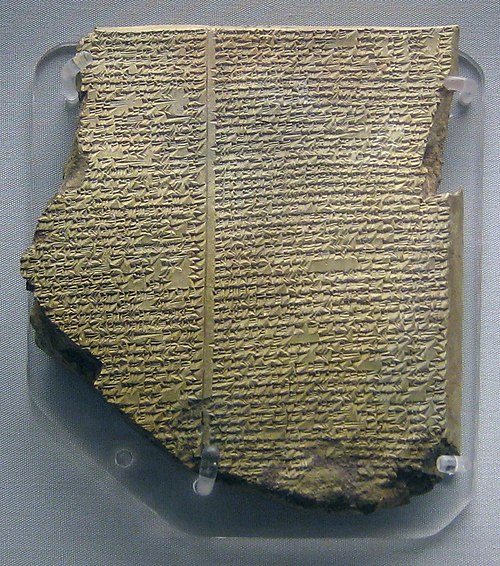
Photo by Andrew West, via Wikimedia Commons, licensed under CC BY-SA 3.0

If an event like the Flood actually happened, this would be worldwide and there would be other accounts to verify this. Something of this magnitude couldn't possibly have been recorded by one source only and sure enough, there is!
Frazer meticulously examines numerous flood accounts from diverse regions, highlighting their similarities to the biblical account in Genesis. Frazer notes that these flood stories are found in various parts of the world, including Africa, the Indian Archipelago, New Guinea, Australia, Polynesia, Micronesia, South America, Central America, Mexico, North America and Africa.
Frazer's comparative analysis suggests that these widespread flood myths may be more than mere coincidence. He proposes that they could be a memory of a significant historical event, possibly a massive flood that left a lasting impact on early human societies.
While the non-biblical accounts contain some variations from the Genesis account, the key points parallel the Flood providing compelling evidence that there was a unique global event as recorded by the Bible.
The Tower of Babel
Significance: Archaeological references such as Borsippa and inscriptions from Nebuchadnezzar
II suggest a historical memory of an unfinished tower associated with language, reinforcing the
biblical account of the Tower of Babel and its cultural and linguistic significance.
Bible: The account in Gen 11:1–9 describes humanity's attempt to build a tower in Babel and the resulting confusion of languages. This account is often discussed in relation to Mesopotamian urban architecture and cultural memory of large temple towers.
The tower was originally built by Nimrod, the first king of Babylon (modern day Iraq) (Gen 11) where the people gathered together in pride against God to build a tower to the heavens. God subsequently judged the city and destroyed the tower. Years later when King Nebuchadnezzar rebuilt the city of Babylon, he also rebuilt the lowest level of the tower in honor of the Chaldean gods and called it the Temple of Spheres in memory of the original with an inscription, translated by Rawlinson (known as the father of Assyriology)
I am Nebuchadnezzar, King of Babylon … my great lord has established me in strength and has urged me to repair his buildings … the Tower of Babylon, I have made and finished … the Tower of Borsippa had been built by a former king. He had completed 42 [cubits?], but he did not finish its head; from the lapse of time it had become ruined … the rain and wet had penetrated into the brickwork; the casing of burnt brick had bulged out … Merodach, my great lord, inclined my heart to repair the building. I did not change its site, nor did I destroy its foundation platform; but, in a fortunate month and upon an auspicious day, I undertook the rebuilding … I set my hand to build it up and to finish its summit. As it had been in ancient times, so I built up its structure ….

Photo by Dr. Amin, via Wikimedia Commons, licensed under CC BY-SA 4.0
Nebuchadnezzar calls this monument the Tower of Babylon (Babel is the old name for Babylon) and clearly shows the spheres or rings of each level of the original tower, still standing to this day. He also describes this tower as an important ancient Babylonian edifice built by a former king that, the workers stopped short in finishing i.e., did not finish its head. Why not? The big clue comes from the second name Nebuchadnezzar gives this tower: the Tower of Borsippa - Borsippa literally means tongue tower, thus providing a link to language. Thus strongly suggest that a significant linguistic event took place in order for Borsippa to receive its unique name?
Joshua's Long Day: Historical and astronomical perspectives
Significance: While the phenomenon where the sun "stood still," can be interpreted in various
ways, other cultures around the world would have been witness to this, and we have accounts from
other ancient cultures also record a long day - the Chinese, Peruvians, Mayans, Aztec, Hindu,
Egyptian, Greeks and Romans.
Bible: Jos 10:12–14
describes a battle in which the sun and moon stand still until Israel's victory is completed.
One of the most intriguing miracles recorded in the Bible is the account of Joshua's Long Day, found in (Jos 10:12–14). According to the Biblical account, Joshua, the leader of the Israelites, was engaged in battle against a coalition of Amorite kings. In a moment of divine intervention, he commanded Sun, stand still over Gibeon and moon over the Valley of Aijalon.. The Bible continues So the sun stood still and the moon stopped, till the nation avenged itself on its enemies… The sun stopped in the middle of the sky and delayed going down about a full day. This event is unprecedented - there has never been a day like it before or since, a day when the Lord listened to a human being. To many, it affirms divine power over nature. To skeptics and historians, it raises questions of cosmology, interpretation and whether any corroborative records exist.
What makes this account more fascinating is that other ancient cultures also record a long day or a disruption of the natural day and night cycle. Though interpretations vary, here are several such accounts that echo the biblical story:
The Chinese
Ancient Chinese historical annals, such as the Chou Dynasty records, mention an event in which the sun set nought in one day. Chinese astronomy was highly sophisticated and such events were often meticulously recorded. In some interpretations, this suggests an apparent slowing or reversal of the sun's movement
The Mexicans
In the 16th century Mexican texts Annals of Cuauhtitlan, records the history of the Cuauhtitlan empire and there is a record of a night that extended far longer than normal
The Peruvians
In the book The Historical Lore of the Peruvians, by Olct (1914), pp206 also records a day that lasted twice the normal time
Mesoamerican Legends: The Mayans and Aztecs
The Popol Vuh, a sacred Mayan text, describes cosmic upheavals and battles among gods in which light and darkness were interrupted or manipulated. Some interpretations of the codices mention that a time came when the sun stood still and did not move for a full day.
Aztec priests related to the Spanish scholar Bernardinho de Sahagun (1499–1590 AD) that the sun had acted in a most unusual way in the ancient past. The Aztecs were very sophisticated in their astronomical calculations and their amazingly precise ability to compute the solar calendar. Bernardinho traveled to Mexico in the generation after Columbus discovered America and records
And when the sun came to rise….
he kept swaying from side to side…
with a rabbit he came to wound the face of the moon
and killed its brilliance…
When both appeared they could not move
nor follow their paths…
And when he had followed his course
only the moon remained there…
Hindu Scriptures
In ancient Indian texts like the Mahabharata, there are tales of unusual solar phenomena. One passage describes a battle during which the sun halted in its path
Herodotus and Egyptian Records
The Greek historian Herodotus in his book The History of Herodotus, Ch 2, claimed that Egyptian priests told him of a period when the sun changed direction four times - the sun moved from its wonted course, twice rising where he now sets and twice setting where he now rises.
The Romans
The Roman writer Seneca reported in his drama Thyestes - The sun reversed course and blotted out the day in mid Olympus noon.
If the event was not true, how does one explain these records from several other civilizations? Clearly an event like this where the sun and moon freeze would be felt all across the world
Stones that speak: Archaeology and the reliability of scripture
Archaeological discoveries have greatly enriched our understanding of the historical setting of the Bible. While not every event has a direct material trace, a wide range of findings consistently confirms the people, places and circumstances recorded in Scripture. From royal seals and military correspondence to imperial records and everyday documents, the evidence demonstrates that the biblical record is rooted in real history. These discoveries continue to foster serious research and thoughtful dialogue, deepening appreciation for the Bible's historical and cultural weight.
The examples above represent only a small portion of the evidence. Many other discoveries further align with Scripture:
- Ancient deities such as Baal, Asherah and Dagan are identified in the correct cultural and regional contexts described in the Bible.
- Major city-states like Hazor, called "the head of those kingdoms" in Jos 11:10, have been excavated, confirming their prominence and scale.
- At Beth-Shan, both Philistine and Canaanite temples have been uncovered, matching the account of King Saul's armor being placed in such locations.
- Key cities associated with King Solomon, including Hazor, Megiddo and Gezer of 1 Kin 9:15 - show consistent construction patterns, reflecting organized royal building projects.
- The grandeur of Babylon under Nebuchadnezzar II, described in Dan 4:30, was later confirmed through excavation. This was unknown to modern historians until it was confirmed by the German professor Koldewey, who excavated Babylon approximately 100 years ago.
- Babylonian records provide precise dates for events like the capture of Jerusalem in 597 BC. We also know that Belshazzar was king after that because his father Nabonidus, was away from Babylon for about 10 years on archaeological digs.
- Prophecies against Babylon (e.g., Jer 51, 52) have been fulfilled. Nebuchadnezzar wrote that the walls of Babylon would be a perpetual memorial to his name, but Jeremiah said, "The broad walls of Babylon shall be utterly broken" (Jer 51:58) and this has been confirmed.
These findings do not stand in isolation; but when taken together they form a cumulative case. Archaeology continues to uncover a world that matches the biblical record in remarkable detail, reinforcing confidence that Scripture faithfully preserves the history it proclaims.
FAQ - The Archaeological support of the Bible
How do the Dead Sea Scrolls support the reliability of the Old Testament?
The Dead Sea Scrolls, discovered between 1947 and 1956, include fragments from nearly every book of the Hebrew Bible and date from c. 250 BC to 68 AD. The Great Isaiah Scroll, one of the most complete finds, matches the Masoretic Text (later medieval Hebrew text) with over 95% agreement, showing remarkable textual stability across a millennium. This demonstrates that the biblical text has been preserved with high fidelity over time.
Have any archaeological discoveries ever disproven the Bible?
No archaeological discovery has ever conclusively disproven the Bible. On the contrary, many findings have confirmed or at least not contradicted biblical accounts. Archaeology has often served to silence critics and provide greater confidence in the reliability of Scripture.
Can archaeology prove the Bible is true?
Archaeology cannot prove the Bible in a theological sense (such as confirming miracles), but it can verify historical context. It functions as a tool to test the reliability of the setting, people and events described. It proves that Jesus suffered at the hands of the Romans, died on the cross and rose again from Roman historian records. It however cannot prove God spoke to Moses, but it can prove that the towns, customs and geopolitical borders described in the text match the physical reality of that era.
Is there archaeological evidence for King David?
Yes. For decades, skeptics viewed David as a mythological figure, but the Tel Dan Stele (discovered in 1993) contains an inscription referring to the 'House of David, making it the first known extra-biblical inscription that names David. This implies that a dynasty bearing David's name was recognized by surrounding kingdoms, lending external attestation to Israel's royal house as described in the Bible. Additionally, excavations at Khirbet Qeiyafa have revealed a fortified Judean city from the 10th century BC, supporting the existence of a centralized kingdom during the biblical timeframe of David's reign.
Are the New Testament gospels historically reliable?
Yes, from an archaeological standpoint, the Gospels show an extremely high degree of 'local color' accuracy. Discoveries such as the Pilate Stone (confirming the existence of Pontius Pilate) and the Caiaphas Ossuary (the burial box of the High Priest) verify that the Gospels accurately name the political and religious figures of the time. Furthermore, excavations of sites like the Pool of Siloam and the Magdala Synagogue confirm that the authors had a precise, firsthand knowledge of 1st-century Judea and Galilee.